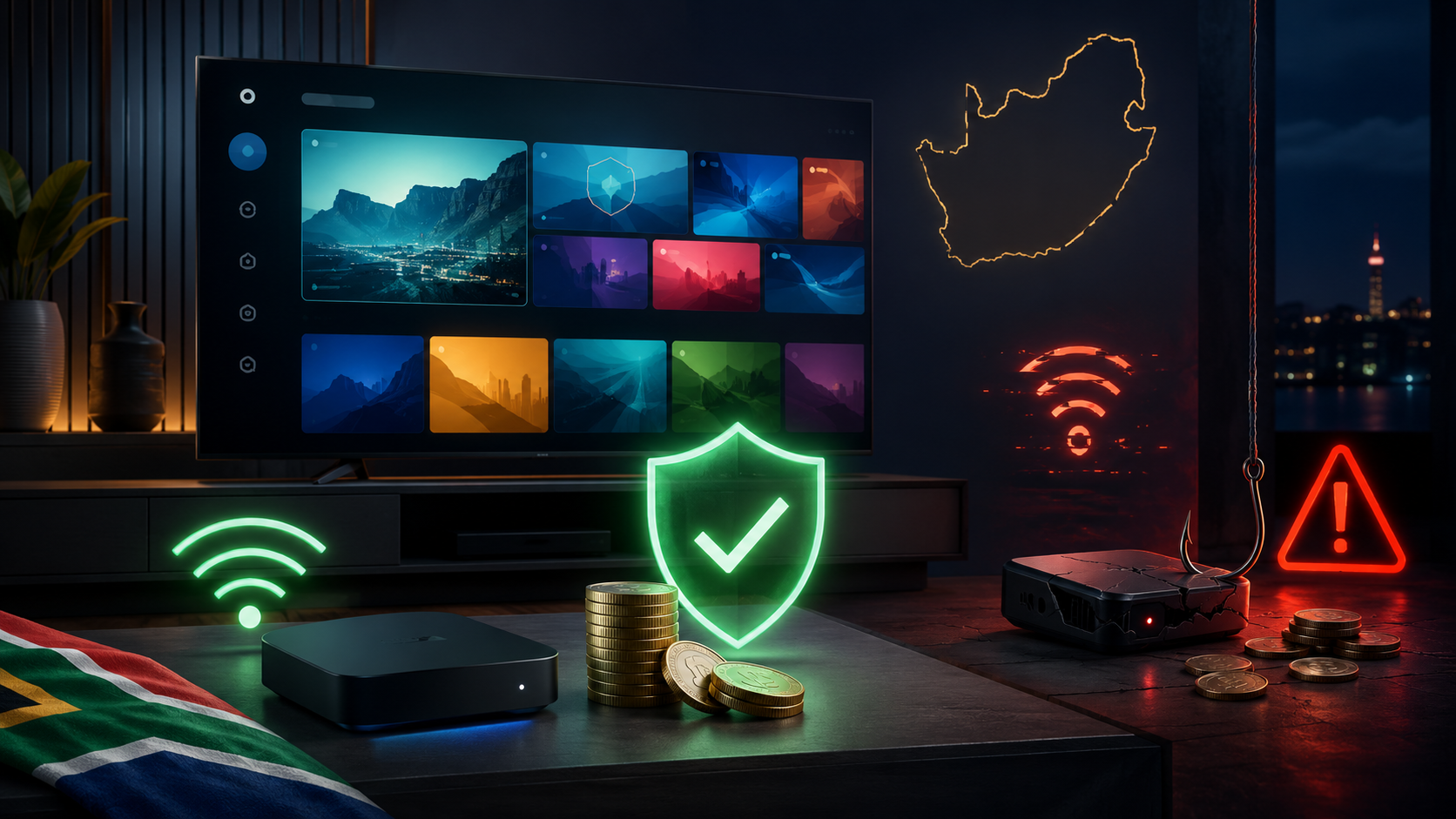
Finding a genuinely affordable cheap iptv subscription without sacrificing reliability or falling for a scam requires a slightly different mindset than simply searching for the lowest advertised price. This guide walks through how to identify real value in the budget end of the South African IPTV market, and — just as importantly — how to spot the pricing traps that catch out buyers chasing the cheapest number they can find.
Table of Contents
- What "cheap" actually means in this market
- Genuine budget value versus a scam
- Realistic budget pricing benchmarks
- Red flags specific to ultra-cheap offers
- How to vet a budget provider properly
- Trade-offs worth accepting at budget pricing
- Trade-offs never worth accepting
- Where genuine savings actually come from
- A practical budget-shopping checklist
- Frequently asked questions
1. What "Cheap" Actually Means in This Market
There's a meaningful difference between a cheap iptv subscription that's genuinely affordable because a provider runs an efficient, well-managed operation, and one that's cheap because it's cutting corners on licensing, infrastructure, or business sustainability. Both can carry a similar price tag, which is exactly why price alone is a poor signal of genuine value in this specific market.
2. Genuine Budget Value Versus a Scam
Genuine budget value comes from a provider deliberately targeting a leaner feature set — a smaller but stable channel list, fewer concurrent streams, more basic support — at a correspondingly lower price, while still being transparent, properly licensed where it matters, and operationally sustainable. A scam, by contrast, often shows the same low price but achieves it through unsustainable business practices, unlicensed content, or an outright intention to disappear after collecting a batch of upfront payments.
3. Realistic Budget Pricing Benchmarks
Based on the pricing landscape covered in our broader subscription cost guide, a genuinely sustainable budget tier in South Africa typically sits around R150–R250 per month. Pricing significantly below this range, particularly anything under R100/month for a full multi-channel package, deserves real scrutiny using the vetting process covered later in this guide.
4. Red Flags Specific to Ultra-Cheap Offers
Beyond the general red flags covered in our broader provider vetting guide, a few patterns are specifically common at the ultra-cheap end of the market: lifetime access for a single flat fee, pricing that undercuts every other provider by a wide margin with no explained justification, and aggressive urgency tactics ("only 10 spots left at this price") designed to rush a purchase decision before proper research can happen.
5. How to Vet a Budget Provider Properly
Apply the same nine-point checklist covered in our full provider vetting guide to any budget-tier provider — rand pricing transparency, verifiable business presence, genuine trial availability, and the rest — without giving a pass on any of these checks purely because the price is attractive. If anything, a lower price should raise your scrutiny threshold rather than lower it, since the margin for error and legitimate cost-cutting is inherently smaller at the budget end of the market.
6. Trade-Offs Worth Accepting at Budget Pricing
A smaller channel list focused on the content your household actually watches, more basic (but still functional) support, and a simpler app interface without premium extras are all reasonable trade-offs for genuine budget savings, provided the core service remains stable and reliable.
7. Trade-Offs Never Worth Accepting
Unclear or hidden renewal pricing, no functional trial period, an untraceable payment method as the only option, and a complete absence of verifiable business presence are red lines regardless of how attractive the headline price looks — these compromise your basic ability to hold the provider accountable if something goes wrong, not just your feature list.
8. Where Genuine Savings Actually Come From
Legitimately budget-priced providers typically achieve their lower cost through a leaner content offering, more efficient (often smaller-team) operations, and a deliberate focus on cost-conscious customers rather than chasing every possible feature and channel. Understanding this helps you distinguish a genuinely lean, honest budget operator from one cutting corners on the things that actually matter — licensing, infrastructure stability, and support.
9. A Practical Budget-Shopping Checklist
Before subscribing to any cheap iptv subscription offer: confirm rand pricing with a stated renewal figure, verify a real trial is available, check for independent mentions beyond the provider's own marketing, and specifically ask what's excluded from the budget tier compared to their standard offering — a transparent provider will answer this clearly, while an evasive answer is itself a warning sign.
10. Frequently Asked Questions
Is it possible to find genuinely reliable cheap IPTV in South Africa? Yes — genuine budget-tier providers exist, typically in the R150–R250/month range, offering a leaner but stable service. The key is applying the same vetting rigour you would at any price point.
Why should I be suspicious of lifetime subscription offers? Ongoing infrastructure and content costs don't stop after a one-time payment, making this pricing model structurally difficult to sustain and a common precursor to a provider shutting down.
What's the biggest mistake people make chasing cheap IPTV? Treating the lowest advertised price as the deciding factor without applying the same vetting checklist used for any other provider — cheap pricing should raise scrutiny, not lower it.
How much should I expect to pay for a basic but reliable IPTV package? Roughly R150–R250 per month for a genuinely sustainable budget-tier service in the current South African market.
Is a cheap provider automatically a scam? No — plenty of legitimately budget-priced, well-run providers exist. The distinction lies in transparency, verifiability, and trial availability, not price alone.
Found a cheap offer you'd like a second opinion on? Reach out to our team and we'll help you check it properly before you pay.
Suggested image: Comparison graphic of legitimate budget pricing versus common scam red flags, alt text: "cheap iptv subscription south africa red flags"
Suggested external dofollow links: Consumer Goods and Services Ombud South Africa, a reputable South African consumer protection resource
Internal sibling links: Article #6 (What an IPTV Subscription Should Cost), Article #3 (IPTV Suppliers vs Resellers), Article #8 (How to Choose an IPTV Provider)
11. Why Scammers Specifically Target Budget-Conscious Buyers
It's worth understanding the underlying dynamic that makes the cheap end of the IPTV market a particularly common hunting ground for scam operations. Budget-conscious buyers are, by definition, actively searching for the lowest available price, which means an operator advertising an unrealistically low cheap iptv subscription rate is deliberately fishing in exactly the pool of buyers most motivated to overlook other warning signs in exchange for the savings. This isn't a coincidence — it's a predictable pattern that shows up across many product categories, not just IPTV, wherever price sensitivity can be exploited to reduce scrutiny of everything else about an offer.
Recognising this dynamic doesn't mean assuming every budget provider is dishonest — plenty of legitimate operators genuinely do serve price-sensitive customers well. It means specifically resisting the natural psychological pull toward reduced scrutiny that an attractively low price creates, and consciously applying the same or even greater diligence than you would at a higher price point.
12. A Closer Look at the Lifetime Subscription Trap
Given how frequently this specific pattern comes up, it's worth unpacking exactly why lifetime or multi-year flat-fee IPTV offers are so consistently unsustainable, beyond the general explanation covered in our broader pricing guide. A provider's ongoing costs — server infrastructure, content licensing or sourcing, support staffing, bandwidth — scale with time and usage, not with a one-time payment collected at signup. A lifetime offer effectively asks the provider to fund years of ongoing costs from a single upfront payment, which only works mathematically if the provider is either dramatically underpricing its true ongoing costs (unsustainable), planning to fund those costs from a continuous stream of new customer acquisitions rather than your specific payment (a structure that collapses once new customer growth slows), or never actually planning to deliver years of service in the first place. None of these underlying realities are visible from the marketing page itself, which is exactly why the lifetime pricing structure deserves scepticism regardless of how professional the surrounding presentation looks.
13. How to Interpret "Too Good to Be True" Pricing Correctly
A useful mental exercise when evaluating an unusually low cheap iptv subscription offer: ask yourself specifically what a legitimate provider's costs actually look like, and whether the advertised price could plausibly cover them. Server infrastructure and bandwidth costs money, properly licensed content costs money, and support staff cost money — even a lean, efficient operation has a realistic cost floor below which sustained operation becomes genuinely difficult. When an offer sits meaningfully below what seems like a plausible cost floor for the service being promised, that gap has to be explained somehow — either through unsustainable pricing, unlicensed content sourcing, or an intention not to deliver long-term service at all. Treating "why can they afford this price" as a genuine question worth answering, rather than simply enjoying the apparent bargain, is one of the more useful habits this guide can offer.
14. Comparing Budget Providers Against Each Other
If you've identified several candidate budget providers that pass an initial legitimacy screen, comparing them against each other requires slightly different criteria than comparing across price tiers generally. At the budget end specifically, pay close attention to exactly what's excluded compared to a provider's own standard tier — is the reduction purely in channel count and concurrent streams, which is a reasonable trade-off, or does it also compromise support responsiveness and trial availability, which are core trust-and-verification signals that shouldn't be sacrificed regardless of price tier? A provider transparent about exactly what you're giving up for the lower price is generally a stronger signal than one whose budget tier feels vaguely under-specified compared to their standard offering.
15. The Real Cost of Chasing the Absolute Lowest Price
It's worth being explicit about the realistic downside of prioritising price above all else in this specific market. A cheap iptv subscription that turns out to be unreliable or disappears entirely doesn't just cost you the subscription fee already paid — it costs you the time spent researching and setting up the service, the disruption of losing access unexpectedly, and the additional time required to research and set up a replacement. Factored honestly, the "savings" from an unrealistically cheap, poorly vetted provider frequently evaporate once you account for this realistic total cost, making a slightly more expensive but properly vetted budget provider the genuinely better value choice in practice, even on pure cost grounds.
16. A Realistic Budget Success Story
To illustrate what genuine budget value looks like in practice: a well-run budget provider might offer a smaller, curated channel list focused specifically on the SA content South African households actually watch most — key SuperSport variants, local channels, a handful of popular international options — at a genuinely sustainable R180–R220/month price point, with a functioning 24-hour trial, rand pricing, and a support team that, while smaller than a premium provider's, still responds to genuine queries within a reasonable window. This kind of provider passes every point on our vetting checklist despite sitting at the lower end of the market's pricing range, demonstrating that "cheap" and "risky" aren't inherently synonymous — the distinction lies entirely in the underlying business practices, not the price tag itself.
17. Final Thoughts on Budget IPTV Shopping
Finding genuine value in the cheap iptv subscription space in South Africa is entirely possible, but it requires resisting the natural instinct to let an attractive price lower your guard on everything else that matters. Apply the same vetting rigour — rand pricing transparency, genuine trial availability, verifiable business presence, honest support responsiveness — regardless of how low the advertised price is, and treat unusually aggressive discounting or lifetime pricing models as a specific reason for heightened scrutiny rather than celebration. Done this way, budget shopping in this market becomes a genuinely useful strategy for reducing your household's entertainment costs, rather than a gamble on whether your chosen provider will still be operating in six months.
For a broader look at provider vetting beyond pricing specifically, see our complete vetting checklist, and if you'd like a second opinion on a specific budget offer you're considering, our team is happy to help — just reach out through our contact page.
18. Understanding the Full Cost of Ownership at the Budget Tier
When evaluating a cheap iptv subscription, it's worth thinking beyond just the monthly subscription figure to the full cost of ownership across a realistic first year, a concept covered in more depth in our broader pricing guide but worth applying specifically to budget shopping. A genuinely cheap subscription paired with hardware you already own and a connection that's already adequate represents real, straightforward savings. But if reaching the advertised budget price requires purchasing a specific bundled device from the provider, or if the budget tier's lower concurrent-stream allowance forces your household to purchase a second subscription to cover multiple simultaneous viewers, the effective total cost can end up considerably higher than a single mid-tier subscription would have been in the first place. Always calculate your household's genuine total cost — subscription plus any required hardware or additional streams — before assuming the lowest advertised monthly figure represents your actual best value option.
19. Budget Shopping During Promotional Periods
South African IPTV providers, like many subscription businesses, periodically run promotional pricing around specific calendar moments — Black Friday, New Year, or the start of a new sport season. These periods can offer genuine value if the underlying provider passes your full vetting checklist, but it's worth being particularly cautious during high-pressure promotional windows specifically because urgency and scarcity messaging ("this price ends tonight") is a well-established tactic for reducing careful consideration regardless of industry. If you encounter an attractive promotional price, it's worth taking the same time to vet the provider properly that you would at any other time, even if that means missing a specific promotional window — a provider confident in its value proposition will typically run similar promotions again, while a provider relying on manufactured urgency to prevent proper research deserves exactly the scrutiny that urgency is designed to discourage.
20. How Currency and Payment Processing Affect Budget Pricing Specifically
Budget-tier providers are somewhat more likely than premium providers to rely on international payment processors or cryptocurrency specifically to minimise their own operating costs, which circles back to the payment method risk covered in our broader vetting guide but deserves specific mention here given how directly it interacts with budget shopping. A genuinely cheap subscription that requires an unfamiliar or untraceable payment method effectively transfers additional risk onto you as the buyer in exchange for the lower price — worth factoring into your overall value assessment rather than treating price and payment method as entirely separate considerations. A slightly higher-priced budget provider offering standard, traceable payment methods may represent better genuine value than the absolute cheapest option once this risk transfer is properly accounted for.
21. Building Household Consensus Around Budget Trade-Offs
For households where more than one person will be using the IPTV subscription, it's worth having an explicit conversation about which trade-offs are acceptable at the budget tier before subscribing, rather than discovering disagreement after the fact. A smaller channel list might be perfectly acceptable to one household member but a genuine disappointment to another who was hoping for broader international content access; a lower concurrent-stream limit might work fine for a household that rarely watches simultaneously but cause real friction in one where multiple people frequently want to stream different content at once. Having this conversation explicitly before committing to a specific budget tier — rather than assuming everyone shares the same priorities — helps ensure the genuine savings from a budget subscription translate into actual household satisfaction rather than a source of ongoing minor friction.
22. When Budget Pricing Genuinely Isn't the Right Choice
It's worth being honest that budget-tier IPTV isn't automatically the right choice for every household, even when a genuinely legitimate, well-vetted option is available. Households with specific, non-negotiable content priorities — full international channel access, high concurrent-stream needs, 4K content as a genuine priority — may find that a mid-tier subscription, chosen deliberately rather than defaulted into, delivers meaningfully better overall value once their specific needs are properly weighed against the savings a budget tier would offer. This guide's goal isn't to push every reader toward the cheapest possible option regardless of fit, but to ensure that when budget pricing genuinely is the right choice for your household's priorities, you're able to find it safely and confidently rather than gambling on an unvetted, potentially risky offer.
23. A Final Practical Shopping Sequence
Bringing this guide together into a practical sequence: start by honestly assessing your household's actual content priorities and concurrent-stream needs, since this determines whether a budget tier genuinely fits before you even start comparing specific providers. Shortlist two or three budget-tier candidates using the general market pricing benchmarks covered earlier in this guide as a sanity check against unrealistically low offers. Apply the full nine-point vetting checklist to each candidate without lowering your standards for the lower price point. Run a genuine trial for your top candidate, following the structured testing process covered in our companion guide, before committing to a longer-term subscription. This sequence takes perhaps an hour of total effort spread across your research process, a small investment relative to a year of subscription cost and the genuine frustration avoided by not falling for an unsustainable or dishonest budget offer.
24. Closing Thoughts
Genuine value at the budget end of the South African IPTV market absolutely exists, but finding it safely requires resisting the specific psychological pull that low pricing creates toward reduced scrutiny, and instead applying — if anything — heightened diligence precisely because the margin for legitimate cost-cutting is narrower at this end of the market than buyers often assume. Understand the realistic cost floor for a sustainable service, watch specifically for the lifetime-subscription and manufactured-urgency patterns covered throughout this guide, and apply the same full vetting checklist you'd use at any price point. Done this way, a cheap iptv subscription can be a genuinely smart household budgeting decision rather than a risky gamble — the difference lies entirely in how carefully you shop, not in whether affordable, trustworthy options exist in this market at all.
25. A Quick Reference Comparison Table
| Signal | Legitimate budget provider | Likely scam or unsustainable operator |
|---|---|---|
| Pricing model | Recurring monthly/annual, rand-based | Lifetime or heavily discounted multi-year flat fee |
| Trial availability | Genuine, functional trial offered | No trial, or heavily restricted demo |
| Payment methods | Standard card/EFT, traceable | Crypto or informal peer-to-peer only |
| Business presence | Findable website, some independent mentions | Single messaging account, no independent footprint |
| Urgency tactics | Rare, genuine occasional promotions | Frequent, aggressive "act now" pressure |
| What's excluded vs standard tier | Clearly and transparently stated | Vague or evasive when asked directly |
26. Why We've Written This Guide This Way
As a business operating in this exact market, we recognise that a guide this focused on scepticism toward ultra-cheap pricing could be read as self-serving — steering readers away from cheaper alternatives and toward pricier options including our own. That's genuinely not the intent. Plenty of legitimately budget-priced providers exist and deserve consideration on their own merits; our concern is specifically with the subset of ultra-cheap offers built on unsustainable pricing or outright dishonesty, which harm not just the individual buyers who fall for them but the broader reputation of the entire South African IPTV industry every time one of these operators disappears and generates another wave of understandable consumer distrust. A market where genuinely well-run budget providers can compete and succeed on fair terms, without being undercut by unsustainable operators who won't be around in six months, is ultimately better for every legitimate business in this space, ourselves included.
27. One Last Word of Encouragement
If this guide has left you feeling like budget IPTV shopping is riskier than you initially expected, that's a reasonable takeaway, but it shouldn't discourage you from finding genuine value at this end of the market. The vetting process covered throughout this guide takes real but modest effort — perhaps an hour spread across your research — and consistently applied, it puts you in a strong position to separate legitimate budget value from the risks that unfortunately cluster around the lowest price points in this specific industry. Approach your search with informed confidence rather than either naive trust in the lowest number you find or excessive suspicion toward the entire budget category, and you'll land on a cheap iptv subscription that genuinely delivers both the savings and the reliability your household is looking for.
28. What to Do Next
If you're actively shopping for budget IPTV right now, start by bookmarking the pricing benchmarks and red-flag patterns covered throughout this guide, then work through your shortlist systematically rather than subscribing to the first attractive offer you encounter. Take the time to run a genuine trial before committing longer-term, even at the budget tier — this single step alone catches the majority of problems this guide has warned about, since a provider unwilling to offer a genuine trial has already failed one of the more telling checks available to you as a buyer. Combine that trial-testing discipline with the pricing scrutiny covered throughout this guide, and you'll be well equipped to find genuine, lasting value in a market that, despite its risks, genuinely does offer real savings for South African households willing to shop carefully rather than simply chasing the lowest number on the page.
Cheap and reliable aren't mutually exclusive in this market — they just require a slightly more careful shopping process than simply picking whatever ranks first for the lowest price.
Take that extra hour, and you'll walk away with real savings instead of a cautionary tale.
29. Summary
To close this guide with the essentials in one place: genuine budget value in South African IPTV sits realistically around R150–R250 per month, achieved through a leaner but still stable and transparent service rather than through unsustainable pricing or unlicensed content. Watch specifically for lifetime pricing offers, manufactured urgency, and untraceable payment methods as the clearest warning signs at this end of the market, and apply the full provider vetting checklist regardless of how attractive a low price appears. Run a genuine trial before committing, calculate your household's true total cost including any required hardware, and have an honest conversation with everyone who'll be using the subscription about which trade-offs are genuinely acceptable. Followed consistently, this approach lets you capture real, lasting savings without taking on the disproportionate risk that unfortunately clusters around the lowest end of this market's pricing spectrum.