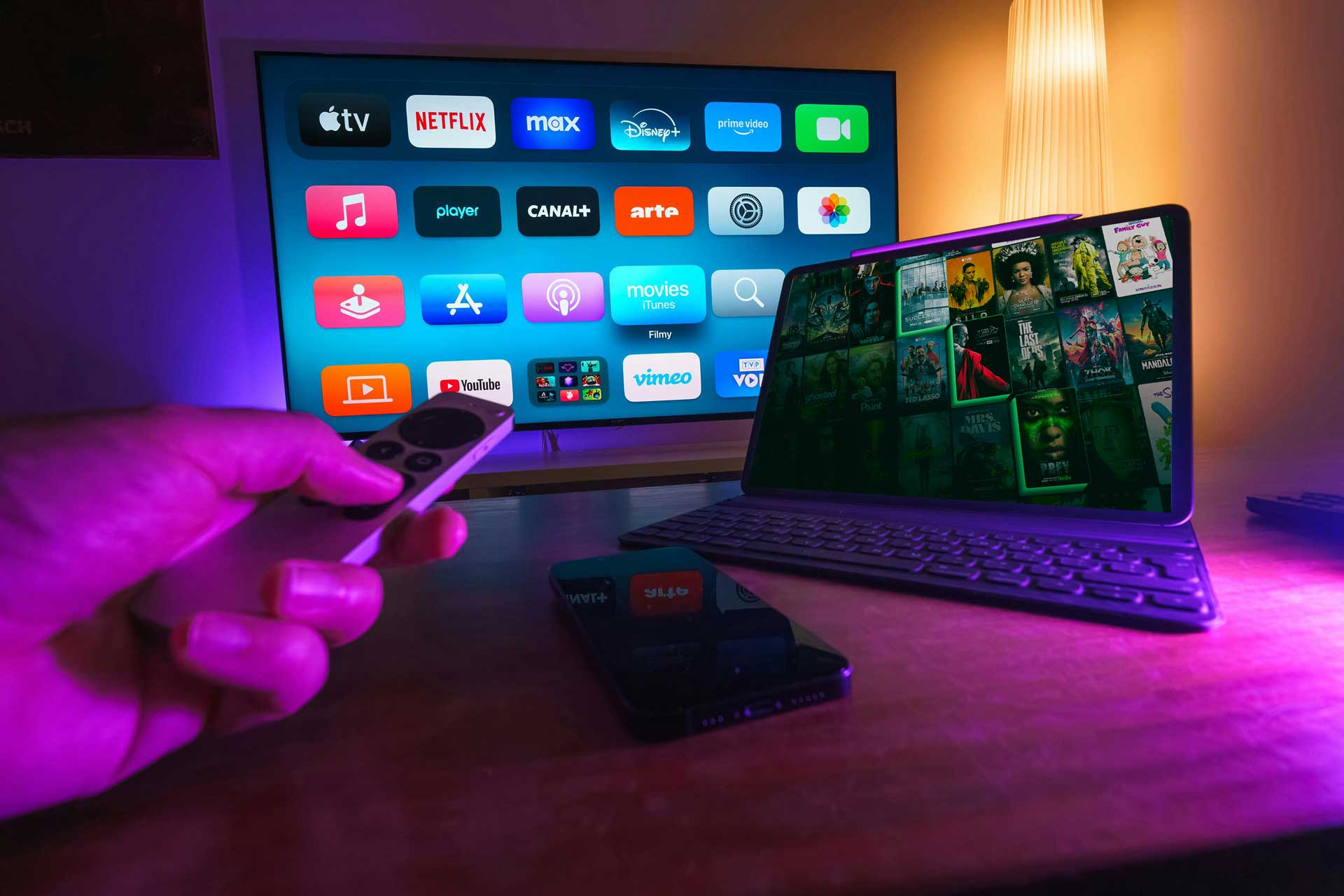
If you've heard friends or family talk about switching away from DStv and mentioned IPTV, but weren't quite sure what they meant, you're in exactly the right place. What is IPTV South Africa households are increasingly asking, and the honest answer is simpler than the technical name suggests. This guide walks you through exactly what IPTV is, how it actually works, what it costs, and what you genuinely need to know before considering it for your own household.
1. IPTV in Plain English
IPTV stands for Internet Protocol Television. Strip away the technical name, and it simply means television delivered over your internet connection, rather than through a satellite dish, an aerial, or a cable line. When you watch Netflix or Showmax, you're already using this same basic delivery method — IPTV services apply that same idea specifically to live television channels, giving you access to hundreds of live channels, including sport, news, and entertainment, streamed directly over your existing internet connection.
2. How IPTV Actually Works, Step by Step
Understanding the actual mechanics helps demystify what can otherwise sound like a complicated technology. A broadcaster or content provider encodes their television signal into a digital video format. An IPTV provider takes that digital signal and makes it available over the internet, typically through a server system designed to handle many simultaneous viewers. Your device — a Smart TV, Firestick, phone, or computer — runs an app that connects to your provider's server, requests the specific channel you want to watch, and displays that stream on your screen, refreshing continuously as you watch, similar to how a YouTube video streams to your device rather than downloading entirely before playing.
3. IPTV Versus Traditional TV: The Real Difference
The core difference between IPTV and traditional satellite or cable television lies entirely in the delivery method, not necessarily in the content itself. Satellite TV, like DStv, broadcasts signals from a satellite to a dish mounted on your property, entirely independent of your home internet connection. IPTV instead relies entirely on your internet connection's stability and speed to deliver that same kind of content. This is the single most important practical difference to understand: your IPTV experience is only as reliable as your internet connection and your chosen provider's server infrastructure combined, whereas satellite TV's reliability depends on your dish, decoder, and the broadcaster's satellite signal instead.
4. What You Need to Get Started
A functioning IPTV setup requires three things: a reasonably stable internet connection (fibre is strongly recommended over capped or mobile data for regular use), a compatible device to watch on — a Smart TV, Amazon Firestick, Android box, or even a phone or computer — and a subscription from an IPTV provider giving you access to actual channels. None of this requires specialised technical knowledge to set up; most households can have a working IPTV setup running within fifteen to twenty minutes once they've chosen a provider and device, covered in more detail throughout our complete IPTV South Africa guide.
5. What IPTV Costs in South Africa
Realistic IPTV pricing in South Africa generally falls between R150 and R400 per month, depending on channel selection, number of simultaneous streams, and provider quality. This sits considerably below DStv Premium's monthly cost, which is a major reason South African households increasingly consider IPTV as an alternative. It's worth understanding upfront that advertised introductory pricing sometimes differs from the renewal price you'll actually pay long-term — always confirm the specific renewal figure before subscribing, a detail covered in full throughout our dedicated subscription cost guide.
6. Is IPTV Legal?
This is one of the most important questions any newcomer should understand clearly. IPTV as a technology is entirely legal — it's simply a delivery method, no different in principle from any streaming service you already use. Whether a specific IPTV provider is operating legally depends on whether that provider holds proper licensing rights for the content it distributes, which can be genuinely difficult to verify as a consumer. We've written a full, honest breakdown of this exact question in our dedicated guide, Is IPTV Legal in South Africa?, which we'd strongly encourage reading before subscribing to anything.
7. Common Misconceptions Worth Clearing Up
"IPTV means free TV." Not accurate — legitimate IPTV still requires a paid subscription to a provider, just like satellite or cable television does.
"IPTV is only for tech-savvy people." Also not accurate — modern IPTV apps are genuinely straightforward, comparable in complexity to setting up Netflix on a new device.
"All IPTV services are basically the same." This is one of the more consequential misconceptions — quality, reliability, and legitimacy vary enormously between providers, which is exactly why proper vetting matters, covered throughout our provider checklist.
8. Is IPTV Right for Your Household?
IPTV tends to suit households prioritising cost savings over DStv's established infrastructure, those wanting broader international channel access, and those with a genuinely stable internet connection able to support consistent streaming. It may be less suited to households in areas with unreliable internet infrastructure, or those who strongly value the guaranteed licensing certainty and decades-long support infrastructure a major satellite broadcaster provides.
9. Getting Started Safely
If you've decided IPTV genuinely suits your household, the safe path forward involves three steps: choosing a device suited to your needs, covered in our device comparison guide; vetting a provider properly using a structured checklist rather than trusting marketing claims alone, covered in our complete vetting guide; and testing thoroughly during a trial period before committing long-term, covered in our trial testing guide.
10. Frequently Asked Questions
What does IPTV stand for? Internet Protocol Television — television content delivered over an internet connection rather than satellite, cable, or terrestrial broadcast.
Do I need special equipment for IPTV? A compatible device (Smart TV, Firestick, Android box, phone, or computer) and a stable internet connection are all you genuinely need.
Is IPTV cheaper than DStv? Generally yes, particularly compared to DStv Premium, though actual savings depend on choosing a well-vetted provider and confirming genuine renewal pricing.
Can I watch live sport on IPTV? Yes, most IPTV providers offer live sport coverage including rugby, PSL football, and cricket, though coverage varies by provider and is worth verifying directly.
Is IPTV difficult to set up? No — most setups take fifteen to twenty minutes and involve installing an app and entering login details, comparable to setting up any other streaming app.
Still have questions about what IPTV is or whether it's right for your household? Reach out to our team and we're happy to walk you through it.
Suggested image: Simple explainer diagram showing how IPTV delivers content from provider to device, alt text: "what is iptv south africa explainer diagram"
Suggested external dofollow links: ICASA broadcasting regulation reference, MyBroadband South African connectivity coverage
Internal sibling links: Article #1 (Best IPTV South Africa), Article #5 (Is IPTV Legal in South Africa), Article #14 (IPTV South Africa: The Complete 2026 Guide)
11. A Deeper Look at How IPTV Streams Actually Reach Your Screen
To really understand what is iptv south africa viewers are switching to, it helps to walk through the technical journey a stream takes in a bit more detail, without getting lost in jargon. When a broadcaster produces a live rugby match, that signal gets encoded into a digital video format — commonly H.264 or H.265 — which compresses the video considerably while preserving watchable quality. An IPTV provider ingests this encoded signal and distributes it across a content delivery network (CDN), essentially a network of servers positioned to handle large numbers of simultaneous viewers without any single server becoming overwhelmed. When you open your IPTV app and select a channel, your device sends a request to the nearest available server, which begins streaming that encoded video to you in small, continuous chunks — this is why IPTV playback typically starts within a few seconds rather than requiring a full download, and why a brief network hiccup shows up as a moment of buffering rather than the stream stopping entirely.
12. Why Understanding This Matters Practically
This technical background isn't just interesting trivia — it directly explains why certain problems occur and how to think about them. A stream that buffers specifically during peak hours, for example, usually indicates the provider's server infrastructure is under-provisioned for the number of simultaneous South African viewers at that time, rather than a fault with your specific internet connection. Understanding this distinction is exactly why our broader best IPTV South Africa testing weighs peak-hour performance so heavily — it's testing precisely the part of the system most likely to reveal a genuine quality difference between providers, rather than testing your own home connection, which remains constant regardless of which provider you choose.
13. IPTV Compared to Other Streaming Services You Already Know
If you've used Netflix, Showmax, or YouTube, you already have a working mental model for how IPTV functions, even if you haven't thought of it that way before. The key difference is that Netflix and Showmax deliver pre-recorded, on-demand content you can pause, rewind, and watch whenever you like, while IPTV's core offering is live, linear television — the same broadcast schedule you'd get from a satellite or cable service, just delivered over the internet instead. Many IPTV providers also offer catch-up and video-on-demand functionality alongside their live channels, blurring this distinction somewhat, but the core, defining feature of IPTV specifically is live channel access delivered over an internet connection.
14. A Realistic Picture of South African Household Adoption
IPTV adoption among South African households has grown considerably over the past several years, driven largely by the cost gap between DStv Premium and IPTV alternatives, alongside continually expanding fibre coverage across South African metros making a stable internet connection more accessible than ever. This growth has happened alongside a market that remains genuinely fragmented in quality, ranging from well-run, properly licensed operators to informal, short-lived resellers — which is exactly why the vetting and legality guidance covered throughout our broader site exists, helping households navigate this growth responsibly rather than jumping in without understanding the landscape.
15. Understanding Channel Packages and What You're Actually Buying
When you subscribe to an IPTV provider, you're typically buying access to a defined package of live channels, often organised into tiers — a basic package might include local South African channels and a handful of general entertainment options, while a premium tier adds extensive SuperSport variants, international content, and sometimes on-demand libraries. It's worth understanding that these packages vary enormously between providers, both in what's actually included and in how accurately that's represented in marketing materials, a topic covered in more depth throughout our best IPTV South Africa comparison — advertised channel counts are frequently inflated, making it worth verifying specific channels that matter to your household directly rather than trusting a large round number.
16. The Role of Your Internet Connection in the IPTV Experience
Since IPTV depends entirely on your internet connection, it's worth understanding what "good enough" actually means practically for South African households. Standard definition IPTV content generally requires a stable connection of at least 5–10 Mbps, while HD content is more comfortable at 15–25 Mbps or higher, and multiple simultaneous streams within the same household require proportionally more bandwidth on top of that. Vumatel, Openserve, and Frogfoot fibre packages commonly available in South African metros comfortably exceed these requirements even at entry-level tiers, while LTE connections can work but are more sensitive to network congestion and data caps, covered in more detail throughout our dedicated data usage guide. Understanding your own connection's realistic capacity, rather than assuming any internet connection automatically supports smooth IPTV viewing, is an important part of setting realistic expectations before subscribing to anything.
17. What Happens During Load Shedding
A genuinely South African-specific consideration worth addressing directly in a beginner's guide: load shedding affects IPTV differently than it affects traditional satellite TV, since IPTV requires your home router and internet connection to remain powered, not just your television and decoder. A UPS (uninterruptible power supply) protecting your router, fibre ONT box, and streaming device is close to essential for maintaining consistent IPTV access through scheduled outages, a topic covered in considerably more depth throughout our broader infrastructure guides. This is genuinely one of the more practical, unique considerations South African IPTV newcomers need to understand that households in many other countries simply never need to think about.
18. Devices You Can Use for IPTV
One of IPTV's genuine strengths is device flexibility — you're not limited to a single dedicated decoder the way traditional satellite TV requires. Amazon Firestick, Android TV boxes, compatible Samsung and LG Smart TVs, iPhones, iPads, Apple TV, Windows computers, and even Kodi media centre setups can all run IPTV apps, each covered in dedicated depth throughout our broader device comparison content. This flexibility means a single IPTV subscription, provided your plan's concurrent-stream allowance supports it, can genuinely serve multiple rooms and device types across your household without needing separate hardware installations the way multi-room satellite setups typically require.
19. Understanding Provider Legitimacy as a Genuine Skill
Perhaps the single most important thing for any newcomer to understand about what is iptv south africa buyers need to know is this: unlike subscribing to DStv, where legitimacy is guaranteed by a single, well-established, regulated broadcaster, the IPTV market requires you to actively evaluate legitimacy yourself. This isn't meant to be alarming — plenty of genuinely well-run, trustworthy providers exist — but it does mean approaching your first subscription with a checklist mindset rather than assuming every professional-looking website represents an equally professional, reliable operation. Our complete nine-point vetting checklist walks through exactly what to look for: rand pricing transparency, verifiable business presence, genuine trial availability, and several other factors that meaningfully separate reliable providers from riskier ones.
20. A Simple Analogy for Understanding IPTV
If the technical explanation still feels abstract, here's a simple analogy that captures the essence of IPTV without oversimplifying it inaccurately: think of traditional satellite TV like a radio station broadcasting to anyone with an antenna tuned to the right frequency, regardless of how many people are listening simultaneously. IPTV, by contrast, is more like a phone call — your device specifically requests a stream from a server, and that server sends content directly to you, meaning the server needs enough capacity to handle every simultaneous "call" from every viewer at once. This is precisely why a provider's server infrastructure and capacity planning matters so much to your actual streaming experience — unlike broadcast radio or satellite TV, where the number of listeners doesn't affect signal quality, IPTV's quality genuinely depends on how well a provider has planned for its total simultaneous viewer load, particularly during South African peak-viewing hours like a Saturday afternoon rugby match.
21. A Quick Reference Comparison Table
| Factor | Traditional Satellite TV (DStv) | IPTV |
|---|---|---|
| Delivery method | Satellite signal to dish | Internet connection |
| Dependency | Dish, decoder, satellite signal | Router, ONT, provider server infrastructure |
| Typical monthly cost | Higher, especially Premium tier | Generally lower, R150–R400 range |
| Setup | Dish installation, decoder | App installation on existing device |
| Device flexibility | Requires decoder per viewing point | Works across many device types |
| Licensing certainty | Guaranteed | Depends on specific provider — verify directly |
22. What South African Newcomers Often Get Wrong
Beyond the misconceptions covered earlier, a few specific mistakes catch out first-time South African IPTV buyers repeatedly. Assuming any advertised price is the price you'll actually pay long-term, without checking renewal terms, is one of the most common — covered in full throughout our subscription cost guide. Skipping a proper trial period, or testing only during a quiet weekday afternoon rather than a genuine peak-hour or live sport session, is another — our trial testing guide covers exactly how to test properly. And assuming every IPTV provider is equally legitimate, without applying any structured vetting, is perhaps the most consequential mistake of all, one this entire guide has aimed to help you avoid from the very start of your research.
23. Building Your Own Understanding Going Forward
This guide has aimed to answer the fundamental "what is iptv south africa" question clearly, but it's genuinely just the starting point for a household's broader IPTV research. From here, we'd recommend working through the specific pieces relevant to your situation: understanding the legal landscape properly, covered in our dedicated legality guide; choosing a device suited to your household, covered in our device comparison guide; and applying structured vetting before subscribing to any specific provider, covered throughout our broader content. Our complete IPTV South Africa guide ties all of these pieces together into a single reference point worth bookmarking as you continue your research.
24. Final Thoughts
Understanding what is iptv south africa households are increasingly adopting doesn't require any special technical background — at its core, it's simply television delivered over the internet rather than satellite or cable, offering genuine cost savings and device flexibility in exchange for a dependency on your internet connection and a need for careful provider vetting that traditional satellite TV doesn't require. Armed with the fundamentals covered throughout this guide, you're now equipped to move confidently into the more detailed research — pricing, legality, device selection, and provider vetting — covered throughout the rest of our site, rather than starting from a place of confusion about what this technology actually is and how it genuinely works.
If any part of this explainer left you with a specific question, our team is happy to help directly — reach out through our contact page and we'll walk you through whatever's still unclear.